
The Electoral Act 2026 establishes financial limits intended to prevent the excessive concentration of campaign resources in the hands of a few individuals. Section 92(8) provides that an individual or other entity must not donate more than ₦500 million to a candidate. The provision is significant because it recognises that the influence of money in elections must be regulated, not left entirely to the discretion of wealthy donors or political interests.
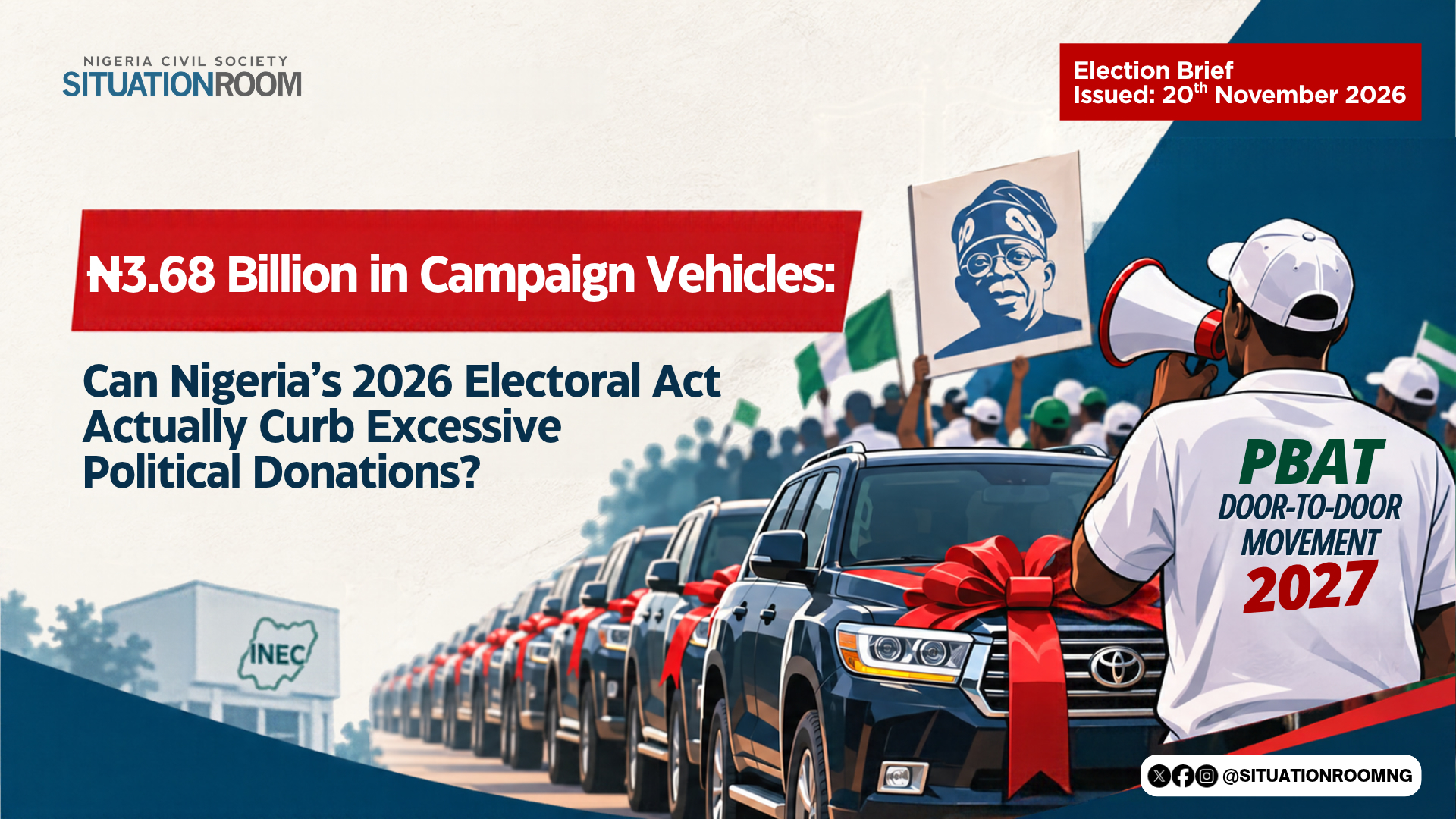
The reported distribution of 633 campaign vehicles valued at approximately ₦3.68 billion by Government Ekpemupolo, popularly known as Tompolo, through the PBAT Door-to-Door Movement 2027 has reignited concerns about the transparency and regulation of political campaign financing ahead of Nigeria’s 2027 general elections.
The PBAT Door-to-Door Movement 2027 is a grassroots political campaign founded by Tompolo to mobilise support for President Bola Ahmed Tinubu’s re-election bid. Although the vehicles were reportedly donated to the movement rather than directly to the presidential candidate or the All Progressives Congress (APC), their intended purpose places the contribution within the wider context of resources being mobilised to advance a candidate’s electoral interests. This raises an important question about the reach of the Electoral Act 2026: does the use of a separate campaign movement to receive and deploy political contributions change how such donations should be treated under the law?
The reported vehicle donations expose important questions about the scope of the restrictions in the Electoral Act 2026. Does the ₦500 million ceiling apply only to direct monetary donations, or does it also cover the commercial value of vehicles and other assets supplied to support a candidate’s campaign? If a contribution is made in kind rather than in cash, should its value be excluded from the calculation of a donor’s total contribution? And where resources are channelled through a campaign movement or an intermediary organisation, how should responsibility for the donation be attributed?
These are not merely technical questions. If substantial material support is treated differently simply because it is delivered in the form of vehicles, equipment, logistics or other services rather than money, the purpose of campaign finance regulation could be undermined. The value of a contribution does not diminish because it is made in kind rather than in cash.
Importantly, Section 91(1) empowers the Independent National Electoral Commission (INEC) to limit the amount of money or other assets an individual may contribute to a political party or candidate, and to demand information on the amount donated and its source. Section 91(2) also provides penalties for individuals and political parties that exceed the limits prescribed by the Commission. The Act therefore recognises contributions beyond cash and provides consequences for breaches of prescribed limits. However, the effectiveness of these provisions depends considerably on how INEC establishes, interprets and enforces those limits.
Section 94 of the Act establishes disclosure requirements for political party contributions. While subsection (1) prohibits political parties from accepting anonymous monetary or other contributions, gifts or property, subsection (2) requires parties to maintain accounts and asset registers recording all contributions and the names and addresses of persons or entities whose contributions exceed ₦100 million. However, disclosure of a donor’s identity does not, in itself, exempt a contribution from the financial limits prescribed under the law. Clause 39(1) of INEC’s Regulations and Guidelines for Political Parties 2026 sets a ₦500 million contribution limit for political parties and aspirants, while Clause 39(2) permits a political party to accept contributions exceeding that amount provided it identifies and discloses the source to the Commission. This raises a broader question about whether disclosure alone is sufficient to address the concentration of financial influence in political parties, particularly where contributions run into billions of Naira.
Given that the Electoral Act 2026 does not expressly prescribe a specific expenditure ceiling for political parties, Section 93(2) places the responsibility on INEC to determine such limits in consultation with political parties. However, the Commission’s failure to clearly establish and demonstrate the effective application of these limits raises serious concerns about the regulation of campaign financing and accountability in political party expenditure.
Ultimately, campaign finance regulation is not intended to prevent citizens from supporting candidates or participating in political activities. It is meant to ensure that financial influence does not become so concentrated that it distorts electoral competition, advantages those with access to extraordinary wealth or weakens the principle that political power should derive from the free choice of voters. When one individual is reported to have provided campaign resources estimated at ₦3.68 billion to a movement established to support a presidential candidate, the public is entitled to ask how such a contribution is classified, disclosed and assessed under the law.
The credibility of the 2027 elections will depend not only on the integrity of voting, accreditation and results management, but also on the fairness of the political environment in which candidates compete. A system in which substantial campaign resources can be mobilised through separate political movements without clear disclosure and effective oversight risks deepening inequalities between political actors and eroding public confidence in the electoral process.
INEC must therefore demonstrate that the provisions of the Electoral Act 2026 are not merely statutory declarations, but enforceable safeguards. The Commission must clarify the treatment of third-party campaign contributions, address inconsistencies in the legal framework and demonstrate that political party contribution and expenditure limits are being effectively monitored and enforced. Political parties, candidates, campaign movements and donors must also recognise that transparency is not optional simply because contributions are made in vehicles rather than cash, or channelled through organisations distinct from the candidates they support. The test of Nigeria’s campaign finance framework will be whether it can follow the money, account for the assets and hold those involved to the same standards, regardless of their political influence or economic standing.
INEC must therefore demonstrate that the provisions of the Electoral Act 2026 are not merely statutory declarations, but enforceable safeguards. The Commission must clarify the treatment of third-party campaign contributions, address inconsistencies in the legal framework and demonstrate that political party contribution and expenditure limits are being effectively monitored and enforced. Political parties, candidates, campaign movements and donors must also recognise that transparency is not optional simply because contributions are made in vehicles rather than cash, or channelled through organisations distinct from the candidates they support. The test of Nigeria’s campaign finance framework will be whether it can follow the money, account for the assets and hold those involved to the same standards, regardless of their political influence or economic standing.