
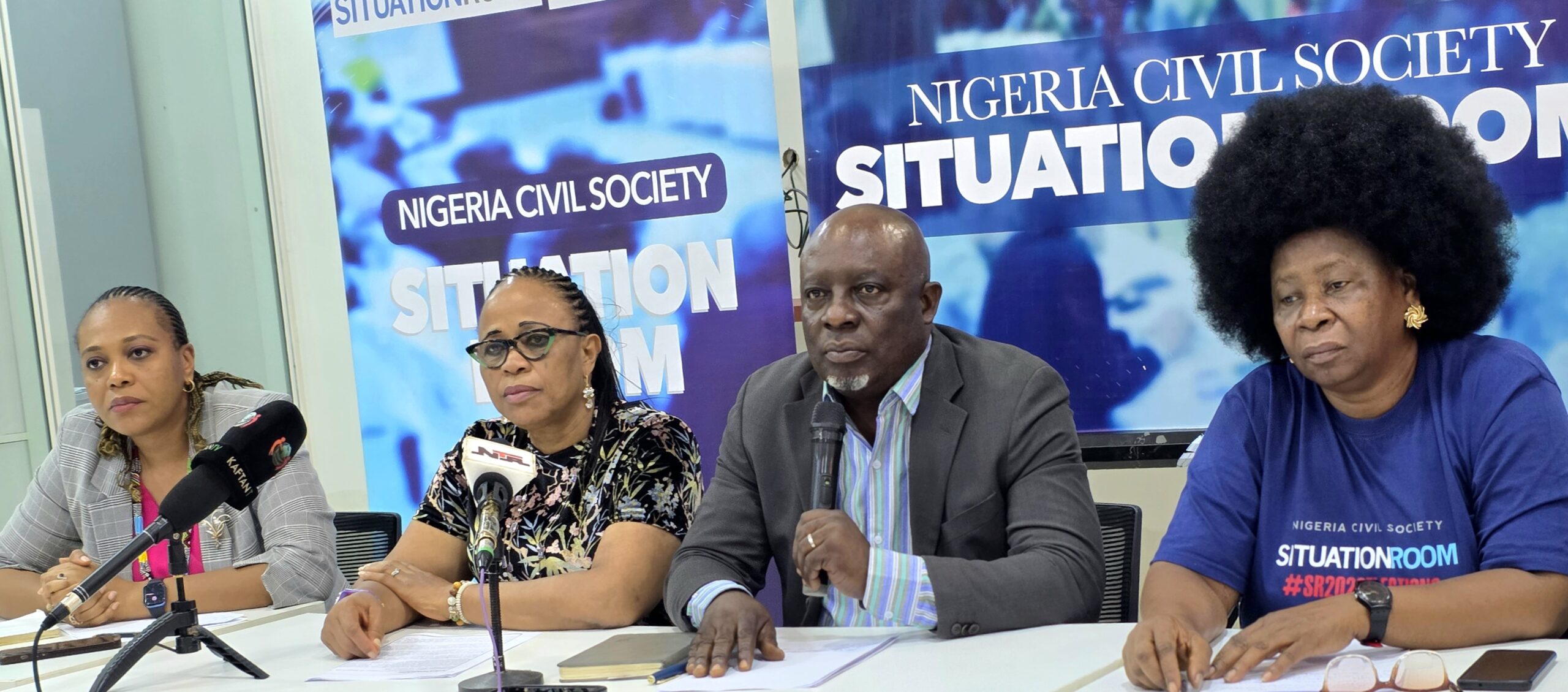
Issued in Abuja on Monday, 15th September 2025
The Nigeria Civil Society Situation Room (Situation Room) joins the global community in commemorating the International Day of Democracy 2025, a United Nations-recognized day to review the state of democracy worldwide, promote the values of freedom, participation, and human rights, and encourage governments and individuals to strengthen democratic institutions and processes globally. This year’s theme “From Voice to Action” resonates deeply with Nigeria, where transforming citizen voices into meaningful electoral participation is essential for building trust, fostering dialogue, and countering shrinking civic spaces amid rising disinformation and insecurity.
Today is not just a day of reflection on the state of democracy in Nigeria but on the state of the nation and provides an opportunity to identify areas where improvements are needed. Nigeria is at a crucial juncture in its democratic journey, having marked 26 years of democratic rule this year, since the return to civil rule in 1999.
In July 2025, the Situation Room released a report on the ‘Current State of Democracy in Nigeria’ where it noted that as at 2025, democracy in Nigeria still remains fragile, marked by institutional weaknesses, electoral distrust, and public disillusionment. Although some progress has been made, three fundamental principles that form the bedrock of democracy – cultural values, political leadership and the electoral process – are being confronted by systemic corruption, growing disillusionment and erosion of cultural values.
In addition, over the couple of months, we have seen systematic attempts to decimate political opposition and render our electoral process to be a choiceless ballot for the voters. These tactics include state-sponsored infiltration and destruction of other political parties, harassment of journalists and punitive targeting of civil society organisations to make it difficult for them to freely operate and determination to undermine the independence and autonomy of the election management body.
State of the Economy
The current State of the Economy presents some paradox – while the Government lauds itself for bold reforms including the removal of fuel subsidies, which freed up funds for State allocations, infrastructure development, and fiscal restructuring, challenges persist. The country continues to struggle with inflation, a weakened currency, rising debt, and widespread poverty, posing serious threats to economic stability. The failure of our democracy to deliver dividends to citizens, the failing public service delivery, lack of standard social amenities in healthcare and education, expanding impunity as well as indiscipline in public finance management and accountability emphasises the strong link between democracy and poverty.
Insecurity
Nigeria continues to face widespread security challenges, with terrorism, banditry, and communal conflicts disrupting national stability. Despite some efforts by the government, including increased military operations in the North-East, results have been mixed. While some governors in conflict-prone regions acknowledge improvements in counterterrorism strategies and enhanced military coordination, insecurity remains a major obstacle to economic and social development. These threats occur daily within and across Nigeria’s borders, with cross-border activities, particularly in the Sahel region, further complicating stability.
Communal Clashes and Ethnic Conflicts
Ethnic tensions fuel persistent communal clashes, particularly in Plateau, Benue, and Taraba States. Disputes between herders and farmers over land have led to thousands of deaths and mass displacement. Violence in the Middle Belt region continues to escalate, driven by competition for resources and ethnic divisions. Addressing banditry, insurgency, and communal conflicts requires policy reform, enhanced intelligence gathering, military coordination, and community engagement in areas where significant progress remains elusive.
Electoral Integrity and Democratic Outlook
The 2023 general elections, despite technological upgrades like the BVAS, were marred by logistical failures, voter suppression, lack of transparency in the election results transmission and judicial controversies. Concerns over judicial independence, suppression of dissent, and weakened democratic institutions remain prevalent. Situation Room continues to condemn the breach of the 1999 Constitution and the events that led to the declaration of the State of the Emergency in Rivers State. This is not good for our democracy; it shows Executive overreach and a troubling erosion of democratic norms despite calls from well-meaning Nigerians to stop the State of Emergency.
The timing of the Continuous Voter Registration exercise is a welcome development which avails first-time voters, especially those just turning 18, the opportunity to register and to facilitate transfers or replacements ahead of the 2027 general elections. By the third week, INEC recorded an impressive 3,544,850 registrations, with Osun State alone seeing 393,269 in the first week and Lagos State following closely. However, this promising process has been fraught with serious challenges that threaten its credibility, inclusiveness, and effectiveness. Field reports and media coverage reveal a mixed landscape: In Lagos State, the process has been described as largely seamless despite crowds and delays. In contrast, low turnout in Benin (Ikpoba-Okha and Oredo LGAs) reflects voter fatigue, while Osun State has seen frustrations over slow procedures, ineffective pre-registration, and allegations of politicization. Enugu State experienced a complete standstill due to unannounced office relocations, reinforcing perceptions of marginalization in the South-East. In Kaduna State, technical issues, insecurity, poverty, and absent INEC officials have deterred participation, with citizens expressing mistrust. Network failures, portal glitches, and incomplete registrations have led to abandoned efforts, inflating pre-registration figures without corresponding completions. Low turnout in the South-East and parts of the North stems from apathy, insecurity, and logistical barriers, while social media amplifies concerns over NIN integration (fears of surveillance), clashes in Kano State, absent officials, socio-economic hurdles like transport costs, and deep-rooted distrust in the electoral system. These challenges reveal how technical, structural, and security gaps can muffle voices and stall action, standing in stark contrast to the International Day of Democracy’s call for empowered participation.
Some quick recommendations to make the exercise smoother include the following:
- The expansion of physical registration access in rural and underserved areas.
- The deployment of mobile registration units to address security and transport challenges.
- Launch targeted public awareness campaigns, especially in local languages.
- Addressing of technical glitches to ensure stable access to the INEC portal.
- Ensuring the safety of registrants and staff, especially in violence-prone areas.
Conclusion
Nigeria’s democracy stands at a crossroads. While the endurance of civil rule is commendable, systemic corruption, cultural fragmentation, and governance deficits continue to threaten democratic consolidation. This administration’s legacy will hinge on its ability to address economic inequality, restore electoral integrity, and foster inclusive governance. Situation Room calls on the National Assembly to finalise and pass into law pending reforms that will restore confidence in our elections and ultimately, our democracy. With off-cycle Governorship elections holding in Anambra, Ekiti and Osun States before the next general elections, INEC will need to conduct free, fair and credible elections within internationally accepted standards and consolidate on Nigeria’s commitment to democracy.
Situation Room condemns the actions of the Senate in the case of Senator Natasha Akpoti and the threats that its actions pose to the rule of law. The continuous denial of her access to the National Assembly and resumption of her legislative duties is a denial of representation to her constituency.
As Nigeria looks beyond 2025, the durability of its democracy will depend on bridging the gap between reform and inclusion. Deepening institutional accountability, rebuilding public trust, fostering civic engagement and national cohesion must move from rhetoric to action which will be critical to shaping Nigeria’s democratic future beyond 2027.
SIGNED:
Yunusa Z. Ya’u
Convener, Nigeria Civil Society Situation Room
Franklin Oloniju
Co-Convener, Nigeria Civil Society Situation Room
Mimidoo Achakpa
Co-Convener, Nigeria Civil Society Situation Room
————————-
The Situation Room is made up of Civil Society Organisations (CSOs) working in support of credible elections and governance in Nigeria numbering more than seventy. The Steering Committee is made up of: Action Aid Nigeria, Centre for Information Technology and Development (CITAD), Centre for Democracy and Development (CDD), Policy and Legal Advocacy Centre (PLAC), CLEEN Foundation, Emma Ezeazu Centre for Good Governance and Accountability (formerly Alliance for Credible Elections, Rule of Law and Accountability Advocacy Centre (RULAAC), Kimpact Development Initiative, Democratic Action Group (DAG), Women’s Rights to Education Programme, Joint National Association of Persons with Disability (JONAPWD), DIG Ebonyi, Life And Peace Development Organization (LAPDO), Rural Youth Initiative, Challenged Parenthood Initiative (CPI), Centre for Health and Development in Africa (CHEDA) and Josemaria Escriva Foundation.
————————-
Call/WhatsApp: 09032999919, 09095050505.
E-mail: situationroom@placng.org
Social Media
- Twitter/Instagram: @SituationRoomNg
- Facebook: Situation Room Nigeria
- Website: www.situationroomng.org