
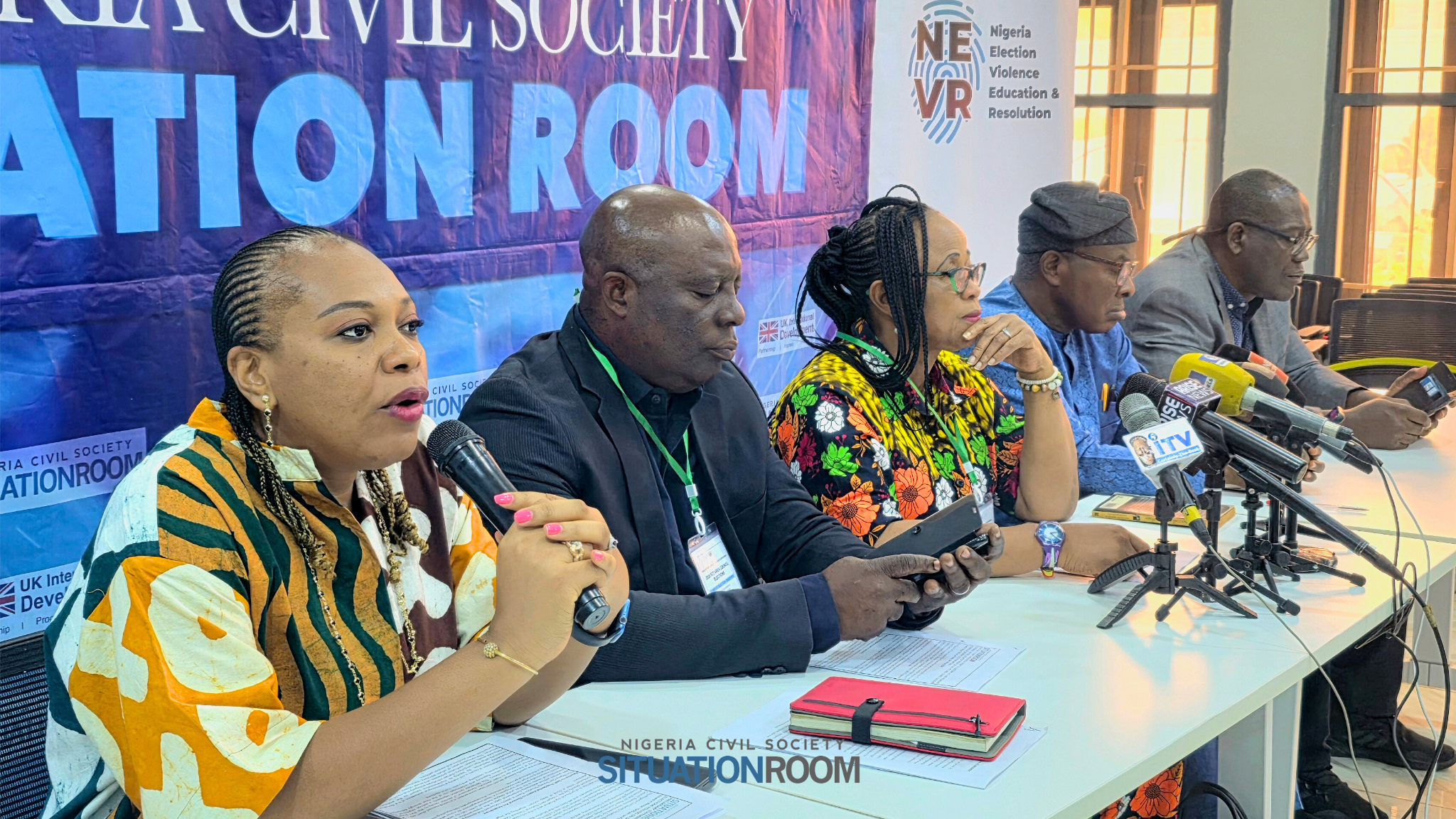
Issued in Abuja: 10:00 am on Friday, 20th February 2026
The Nigeria Civil Society Situation Room (Situation Room) will be observing the 2026 FCT Area Council Elections scheduled for Saturday, 21st February 2026. The election will take place across the six Area Councils (Abaji, AMAC, Bwari, Gwagwalada, Kuje, and Kwali) of the FCT, covering 62 electoral wards and 2,822 polling units. This exercise involves 1,680,315 registered voters competing for 6 Chairmanship and 62 Councillorship seats.
The Situation Room will receive reports from its 68 accredited observers, partner networks and its Election Reporting App deployed for citizen observers to report back to the Situation Room. Kimpact Development Initiative (KDI) and CLEEN Foundation, members of the Situation Room will also deploy observers and will feed into the Situation Room’s reporting of the election.
This election is of profound significance as it is the only local government election in Nigeria conducted directly by the Independent National Electoral Commission (INEC) and is being conducted under a cloud of deep concern regarding the legal framework governing our elections.
Pre-election Political Environment in the FCT
At this time the political environment in the FCT is calm. Situation Room remains mindful of the persistent and historical challenge of voter apathy, in the FCT particularly in urban councils like the Abuja Municipal Area Council (AMAC). We recall with deep concern that in the 2022 FCT Area Council elections, out of the 1,373,492 registered voters at the time, the total voter turnout in AMAC was an abysmally low 5.09%. Situation Room maintains that local government elections, especially in the nation’s capital, should be the gold standard for transparency. However, when citizens feel that the law does not guarantee the transparent transmission of their votes – a sentiment which may now be exacerbated by the failure to mandate real-time electronic transmission of election results in the 2026 Act which reinforces a sense of disillusionment.
We also note the announcement of the FCT Minister declaring a work free day in the FCT today on Friday, 20th February 2026 with approval of the President as well as the restriction of movement from 8pm of Friday, 20th February 2026 to 6pm of Saturday, 21st February 2026. This announcement on restriction of movement creates some confusion and is in contradiction with the announcement of the FCT Police Command who are the security agency statutorily in charge of elections in Nigeria who have announced the usual practice from 6am on the day of the election to 6pm. This is the usual practice and is done so as not to shut out people completely from carrying out their own duties.
Security Risks and Identified Hotspots
Beyond concerns about voter participation, security dynamics remain a critical determinant of electoral integrity. In a strategic meeting held on February 10, 2026, between the National Peace Committee (NPC) and INEC, specific security risks were identified through the NPC’s Election Security Information Hub. Situation Room echoes the concerns raised regarding identified “hotspots” where the safety of voters and the integrity of the ballot are under threat:
AMAC: High risks of vote buying and political intimidation, particularly in urban centers where competition is fiercest.
Gwagwalada: Identified for potential indigene-settler tensions and the presence of political thuggery.
Bwari: At high risk due to ongoing farmer-herder conflicts and the persistent threat of kidnapping, which may deter voters from rural polling units.
Kwali: Faces significant cross-border security pressures that could affect the stability of the poll.
Situation Room notes the deployment of security personnel across the FCT. While we acknowledge the need for safety, we reiterate that security must be obtrusive to criminals but invisible to law-abiding voters. We call on the FCT Commissioner of Police to take charge of Security., ensure free flow of movement for those on Election Duty and that officers prevent vote buying, which has become a recurring decimal in recent off-cycle elections. Security agents must remain non-partisan and prioritize the protection of voters, observers, and INEC officials.
INEC and Election Administration
Operationally, while we note INEC’s commitment to carry out an efficient exercise and deployment of BVAS machines for all 2,822 polling units, the effectiveness of this technology is limited if the final output is not protected by mandatory electronic transmission to the IReV portal.
For tomorrow’s exercise, we expect:
Administrative Transparency: We challenge INEC to prove its commitment to transparency by ensuring 100% real-time upload of Form EC8A to the IReV portal.
Integrity of the BVAS: The Bimodal Voter Accreditation System (BVAS) is expected to function optimally, to prevent the delays that have characterized previous local polls. INEC must ensure that the trained personnel are readily available to handle technical issues swiftly, ensuring that voters are not disenfranchised due to faulty equipment.
Logistical Readiness: Polls must open at 8:30 am across all 2,822 polling units to avoid disenfranchising voters.
Conclusion
Situation Room calls on all eligible voters to come out and exercise their civic duty peacefully. We wish to remind all FCT residents that vote trading is illegal and undermines the development of our democracy. Voters must resist the temptation to exchange their votes for money or other inducements, as their future welfare depends on the choices they make. We enjoin all stakeholders to approach this election with a sense of responsibility and utmost respect for democratic standards.
SIGNED:
Yunusa Z. Ya’u
Convener, Nigeria Civil Society Situation Room
Mma Odi
Co-Convener, Nigeria Civil Society Situation Room
Celestine Odo
Co-Convener, Nigeria Civil Society Situation Room
————————-
Call/WhatsApp: 09032999919, 09095050505
E-mail: situationroom@placng.org
Social Media
Twitter/Instagram: @SituationRoomNg
Facebook: Situation Room Nigeria
Website: www.situationroomng.org