
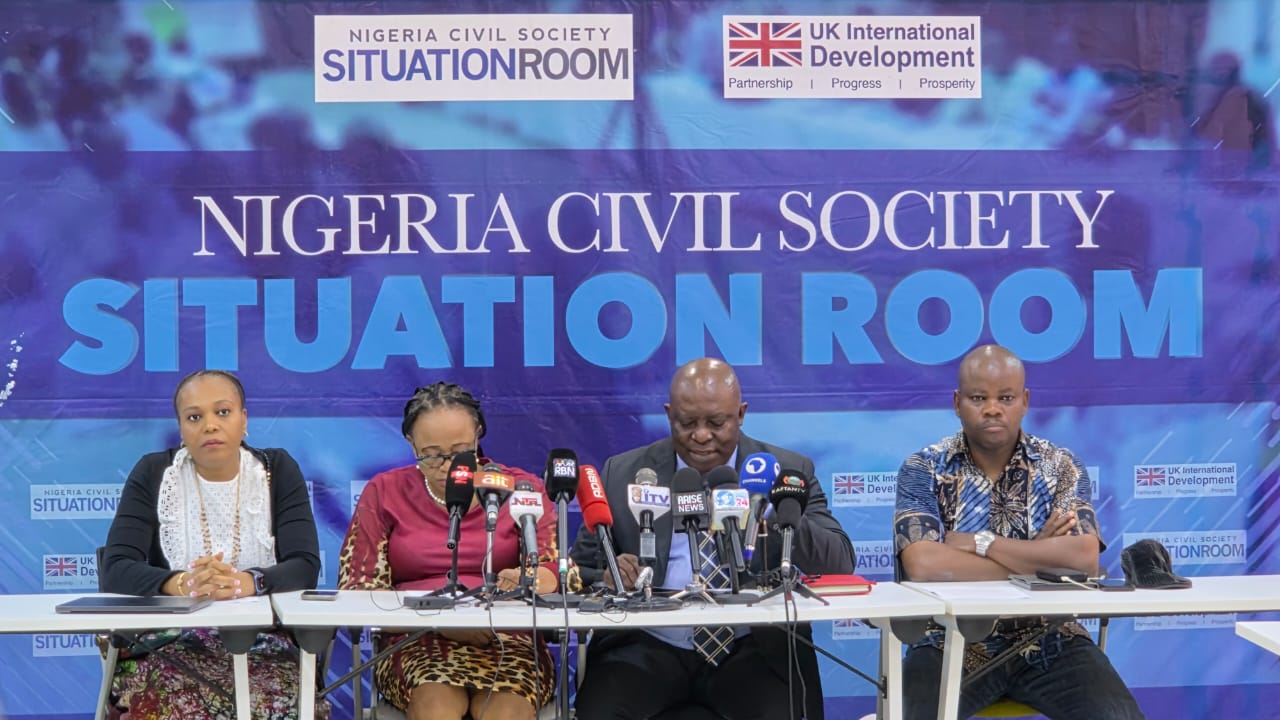
Issued in Abuja: 12:30pm – Monday, 22nd June 2026
INTRODUCTION
The Nigeria Civil Society Situation Room (Situation Room), a coalition of civil society organisations working to support credible, transparent, and inclusive elections in Nigeria, deployed observers across the 16 Local Government Areas of Ekiti State to observe the Governorship Election held on Saturday, 20 June 2026.
OBSERVATION METHODOLOGY
Situation Room’s observation of the 2026 Ekiti Governorship Election combined the deployment of accredited election observers to polling units and the use of citizen observers reporting through the Situation Room Election Accountability Tracker (SEAT) mobile and web application. In addition, the Situation Room received reports from its partner networks deploying observers – Action Aid Nigeria, CLEEN Foundation, Centre LSD and Kimpact Development Initiative (KDI). The Situation Room partners deployed over 200 accredited observers.
In addition to this Statement, Situation Room had issued a Preliminary Statement and an Interim Statement based on reports received from accredited observers and verified citizen observers through the SEAT App. Situation Room makes the following observations:
General Assessment
Situation Room notes that the Ekiti State Governorship Election was conducted in a generally peaceful atmosphere across most parts of the State. Voters were able to exercise their franchise without widespread disruption, while election officials and security agencies largely discharged their responsibilities in accordance with established procedures.
The election represents another important opportunity for democratic consolidation in Nigeria and demonstrates the continued commitment of citizens to democratic participation despite prevailing concerns about voter turnout and public confidence in electoral institutions.
Election Administration and Turnout
Situation Room notes that the Ekiti State Governorship Election was conducted in a largely peaceful atmosphere across the State. Reports received from accredited observers and citizen observers through the SEAT App indicated that election officials and materials arrived on time in a majority of polling units observed between 7:00am and 8:00am. Following deployment, polls commenced early in approximately 92 percent of polling units observed. However, delays in the commencement of voting were reported in some locations due to late deployment of officials and logistical challenges specifically in ST. Georges Primary School, Ijigbo, Ado-Ekiti and ST. Thomas Primary School, Irona, Ado-Ekiti.
Election officials generally followed established procedures for accreditation and voting, contributing to an orderly process in the majority of polling units observed.
Observers reported steady voter participation during the early hours of voting, although turnout varied across Local Government Areas. According to figures announced by INEC, the election was conducted for a population of 1,028,929 who had collected their PVCs representing a 97.1% according to INEC, with 384,940 accredited voters and 382,109 total votes cast. This represents a voter turnout of approximately 37.1 per cent, continuing the trend of low participation that has characterised recent off-cycle governorship elections in Nigeria. While the turnout exceeded that recorded in some recent off-cycle elections, it remains significantly lower than the State’s voter registration and PVC collection figures.
Functionality of Election Technology
The Bimodal Voter Accreditation System (BVAS) functioned satisfactorily in most observed locations. Nonetheless, isolated incidents of technical difficulties were reported, resulting in temporary delays in voter accreditation and voting processes. In most places where BVAS malfunctioned, it failed to authenticate voters especially the elderly using facial detection.
Incidents of BVAS malfunction or delayed activation were recorded in:
- St. Andrew Primary School, Oke-Ila Ward, PU 07 Ado-Ekiti LGA;
- Ward 09, PU 08 (Ayegunle Street) Aiyekere (formerly Gboyin) LGA;
- Ise/Orun LGA, Ward 003, PU 003;
- St Michael’s Primary School, Ado-Ekiti (where voting could not commence due to BVAS activation failure); and
- St. Luke’s African Primary School, Ayede South (Itaji Ward), Oye LGA, where accreditation was significantly delayed. As at 11 am, only four voters had been accredited until BVAS began functioning again about 1 hour later.
Situation Room further notes that the upload of polling unit results to the INEC Result Viewing Portal (IReV) progressed from about 4:30pm when the first upload observed. Reports indicated that over 85 per cent of polling unit results had been uploaded by 7:30pm on Election Day.
Security Environment
The security situation remained generally peaceful in most parts of the State. Security personnel were visible at polling units and election facilities observed. Situation Room, however, received reports of isolated incidents requiring further verification and investigation by relevant authorities.
Compliance with Electoral Procedures
Election officials largely adhered to prescribed voting procedures in observed polling units. Polling officials demonstrated familiarity with election guidelines, and voting was generally conducted in an orderly manner. However, there were inconsistencies between the number of political parties contained in INEC’s earlier communication, printed ballot papers and result sheets. INEC earlier announced 14 political parties, but ballot papers reflected 19 political parties while the result sheets reflected 15 political parties. Voters went ahead to vote for these parties despite not presenting any candidate for the elections.
Additional procedural concerns were also observed in:
- Ekiti West LGA (Ward 5, PU 03) where individuals without voter cards were reportedly allowed to vote upon verification of their names on the register.
- Ado-Ekiti (Ward 07, PU 019), a senior government official reportedly directed that all registered voters (including those absent) should be allowed to vote.
Inclusion and Accessibility
Situation Room observed varying levels of accessibility for persons with disabilities, elderly voters, and nursing mothers. While some polling units made efforts to prioritise vulnerable voters, challenges relating to physical access and voting assistance were reported in certain locations. Situation Room partner, TAF Africa show serious accessibility gaps affecting Persons with Disabilities (PWDs) and elderly voters in several locations, particularly in parts of Ado-Ekiti.
Key concerns around inclusivity include:
- Polling Units located in inaccessible buildings with staircases;
- Voting cubicles placed in ways that undermine ballot secrecy;
- Relocation of polling units without adequate voter communication; and
- Limited availability of disability-inclusive resources.
General Key Concerns
Situation Room notes with concern reports of:
- Alleged incidents of voter inducement in some polling locations;
- Delays in the opening of polls in certain areas;
- Inconsistent adherence to electoral procedures in isolated polling units;
- The persistence of low voter turnout despite extensive voter education efforts.
These issues underscore the need for continuous improvements in electoral administration, enforcement of electoral laws, and civic engagement initiatives.
Looking Ahead
A significant lesson from the Ekiti Governorship Election is the persistent challenge of voter apathy. Despite over one million registered voters and a PVC collection rate of 97.1 per cent, only about one-third of eligible voters participated in the election. This trend raises important questions regarding citizens’ confidence in electoral processes, political parties, and governance outcomes and requires urgent attention from INEC, political actors, civil society organisations, and government institutions.
Situation Room recommends that:
- INEC undertakes a comprehensive review of logistical and operational challenges encountered during the election before the next off-cycle election in Osun State. INEC also should be clear on its procedure for using the PVC during an election going forward. INEC should also ensure that the ballot paper carries the exact number of political parties presenting candidates for an election so as not to create confusion to voters.
- Security agencies need to continue to strengthen mechanisms for preventing electoral offences, including voter inducement and intimidation.
- Political parties deepen internal democratic practices and promote issue-based campaigns.
- The National Assembly, INEC, political parties, and civil society organisations intensify efforts to address declining voter turnout and strengthen public confidence in elections.
- Relevant authorities investigate and prosecute electoral offences in accordance with the law.
Conclusion
Situation Room commends the people of Ekiti State for their peaceful participation in the electoral process and acknowledges the efforts of election officials, security agencies, political parties, observers, the media, and other stakeholders.
As Nigeria prepares for future elections, the lessons from the Ekiti Governorship Election should inform ongoing efforts to strengthen electoral integrity, democratic governance, and citizen participation.
SIGNED:
Celestine Odo
Co-Convener, Nigeria Civil Society Situation Room
Mma Odi
Co-Convener, Nigeria Civil Society Situation Room
————————-
Call/WhatsApp: 09032999919, 09095050505
E-mail: situationroom@placng.org
Social Media
Twitter/Instagram/Facebook: @Situationroomng
Website: www.situationroomng.org