
BACKGROUND AND OBJECTIVES
Following the governorship election held in Anambra State on November 8th, 2025, Situation Room commissioned NOIPolls to conduct a post-election survey to assess eligible voters’ perceptions of the Independent National Electoral Commission (INEC). Citizens were polled based on their experiences in the 2023 General Elections and the Anambra State Governorship Elections. Specific objectives from this survey are as follows:
- Assess residents’ opinions on INEC’s management of the electoral process during the November 2025 governorship election.
- Gauge perceptions of INEC’s performance in the 2023 general election.
- Enable a comparative analysis of INEC’s performance across the 2023 and 2025 elections.
This survey provides valuable insights into the electoral process, informing efforts to enhance transparency and accountability in future elections.
METHODOLOGY
- The survey was conducted in January 2025 via telephone interviews using a fully structured questionnaire to capture the required information from respondents.
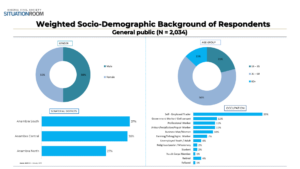
- A total of 2,034 respondents were interviewed across the three senatorial districts in Anambra State.
- Proportionate stratified random sampling was employed to select the number of Nigerians across the three senatorial districts in Anambra state from the NOIPolls Numbers Database, which has access to over 90 million numbers.
- The Telephone interviews were conducted through the NOIPolls Opinion Polling Centre (NOPC), a 60-man call centre dedicated to capturing Nigerians’ opinions daily.
- Data were captured by a team of experienced analysts who conduct surveys professionally.
- The final approved questionnaire was translated into two other major languages (Igbo and Pidgin), and the survey was administered in English, Igbo, and Pidgin English.
DEMOGRAPHIC DISTRIBUTION
SUMMARY OF KEY FINDINGS
The survey findings indicate that voter turnout was higher in the 2023 general elections (82 percent) compared to the 2025 governorship election (71 percent) in Anambra State. The survey assessed INEC’s overall performance during the 2023 general elections and the 2025 governorship election. INEC received positive ratings for its management of the electoral process, with 43 percent of voters rating the 2023 general election as good and 78 percent rating the 2025 governorship election as good. This implies that INEC was perceived to have performed substantially better during the recent governorship election in the state.
Similarly, opinion on INEC’s performance regarding its processes and the conduct of its officials during the 2023 general elections and the 2025 governorship election in Anambra state was positive, with residents highlighting the commission’s preparedness as reflected in high voter access to the INEC list (73 percent and 84 percent respectively) and the prompt arrival of officials (59 percent and 85 percent respectively)
Furthermore, a significant majority (85%) of respondents reported no difficulties during the 2025 governorship elections. However, in terms of vote buying, findings showed a concerning increase, with 22 percent of voters reporting issues of vote buying in their polling units during the 2023 general election. This figure surged to 56 percent during the 2025 governorship election. Interestingly, of the proportion that stated there were incidences of vote buying, 22 percent and 54 percent of voters also claimed that INEC officials were aware of these incidences in 2023 and 2025, respectively.
Additionally, it is worthy to note that only 10 percent of the voters in Anambra state admitted that they had ever visited the INEC website, and of this proportion, 20 percent visited the INEC website for the aim of checking the outcome of election results. Generally, the survey reveals a mixed but positive perception of INEC’s performance, highlighting areas for improvement, particularly in vote-buying and digital engagement.
KEY FINDINGS
Note: ALL THE INTERVIEWED RESPONDENTS HAVE A PERMANENT VOTER’S CARD
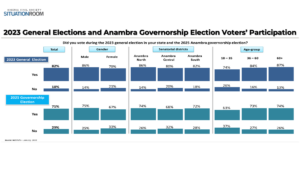
Overall, voter turnout in the 2023 General Election (82 percent) was higher than in the 2025 Governorship Election (71 percent), indicating a significant drop in voter engagement. This trend is consistent across gender, senatorial districts, and age groups, with a noticeable decline in participation for the 2025 election. For instance, male participation dropped from 86 percent in 2023 to 75 percent in 2025, and female participation decreased from 79 percent to 67 percent, highlighting a general decline in voter enthusiasm.
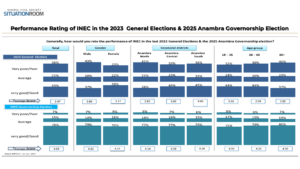
The finding reveals a significant improvement in INEC’s performance, with the “very good/Good” rating soaring from 43 percent in 2023 to 78 percent in 2025, demonstrating a substantial increase in voter satisfaction. This positive shift is reflected in the average score, which increased from 2.97 in 2023 to 4.23 in 2025, suggesting a possible improvement in the perceived effectiveness of INEC.
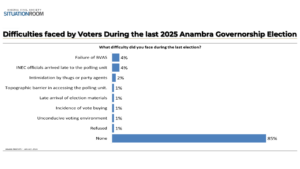
A majority of respondents (85 percent) reported no difficulties, suggesting a relatively smooth voting process for most. However, among those who did experience issues, the most common problems were the failure of the Bimodal Voter Accreditation System (BVAS) and the late arrival of INEC officials, both cited by 4 percent of respondents. Other less frequent issues included intimidation by thugs or party agents (2 percent) and various logistical challenges, such as topographic barriers and the late arrival of election materials (1 percent each), which, while affecting a small percentage, highlight areas for improvement.
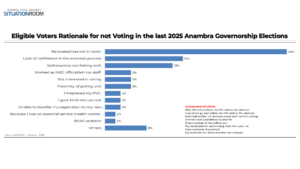
This question explores the reasons why some eligible voters did not participate in the 2025 Anambra Governorship Elections. The primary reason cited was a “Relocation/was not in town,” accounting for 35 percent of non-voters. This is followed by 15 percent who mentioned “Lack of confidence in the electoral process” Other reasons for not voting included being engaged as an INEC official or ad-hoc staff (5 percent), issues with the proximity of the polling unit (5 percent), and personal circumstances such as giving birth (3 percent) or being on essential service (2 percent). The ‘Others’ category (8 percent) includes a variety of issues such as problems with PVC collection, fear of violence, and names missing from the voter list, indicating a range of individual barriers to voting.
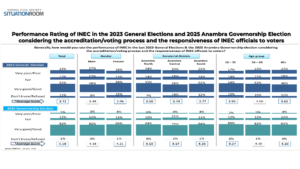
The rating of INEC’s performance, specifically concerning the accreditation/voting process and the responsiveness of its officials, reveals a significant and positive shift in public perception between the 2023 General Elections and the 2025 Anambra Governorship Election. The proportion of voters rating INEC’s performance as “Very good/Good” surged from 52 percent in 2023 to 82 percent in 2025. This substantial improvement is further reflected in the average performance score, which climbed from 3.71 to 4.19. This positive trend was consistent across all demographics, with female voters and the 18-35 age group showing particularly high approval in 2025, at 84 percent and 86 percent, respectively.
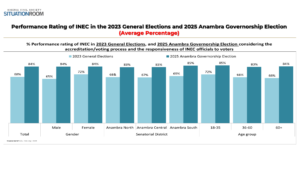
This bar chart visualizes the average performance rating of INEC, comparing the 2023 General Elections with the 2025 Anambra Governorship Election across different demographic groups. The chart clearly illustrates a significant and consistent improvement in INEC’s perceived performance, with the overall average rating increasing from 68 percent in 2023 to 84 percent in 2025. This positive trend is observed across all categories, including gender, senatorial district, and age group, with the most significant jump seen among the 60+ age group, from 66 percent to 84 percent.
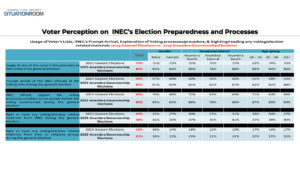
The data reveals a significant improvement in several key areas, with the usage of the voter’s list increasing from 73 percent to 84 percent, and the prompt arrival of INEC officials at polling units jumping from 59 percent to 85 percent. Similarly, the percentage of voters who felt that INEC officials explained the voting process adequately rose from 69 percent to 83 percent. While there was a slight increase in the visibility of voting-related materials from INEC and civic/religious groups, these figures remain relatively low, suggesting an area for further improvement in voter education and information dissemination.
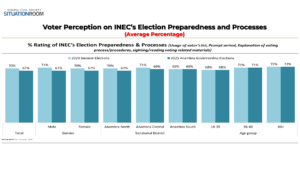
This bar chart provides an aggregated view of voter perception on INEC’s election preparedness and processes, showing a slight dip in the overall average rating from 70 percent in 2023 to 67 percent in 2025. This is an interesting contrast to the previous slides that showed a significant improvement in INEC’s overall performance rating. A closer look at the data reveals that while there were improvements in specific areas, such as prompt arrival and process explanations, the lower visibility of voting materials might have contributed to a slight decline in the overall preparedness rating.
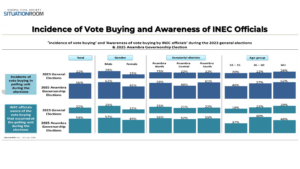
This finding addresses the critical issue of vote buying, revealing a concerning increase in its prevalence during the 2025 Anambra Governorship Election. The incidence of vote buying in polling units surged from 22 percent in the 2023 General Elections to 56 percent in the 2025 election, indicating a significant and troubling trend. This increase is observed across all demographics, with the 60+ age group reporting the highest incidence (62 percent). Similarly, INEC officials’ awareness of vote buying increased from 22 percent to 54 percent, suggesting that, while the issue is more visible, it remains a major challenge to the integrity of the electoral process.
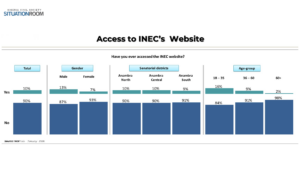
This slide examines the extent to which voters accessed the INEC website, revealing very low online engagement. A staggering 90 percent of respondents reported never accessing the INEC website, while only 10 percent had ever visited it. This low level of access is consistent across all demographics, although younger voters (18-35 age group) show a slightly higher tendency to access the website (16 percent). The data strongly suggests that the INEC website is not a primary source of information for the vast majority of voters in Anambra State, highlighting a need for INEC to improve its online outreach and make its website a more accessible and valuable resource for the electorate.
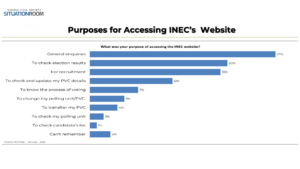
The survey result delves into the reasons why the small percentage of voters who accessed the INEC website did so. The most common purpose for visiting the website was for ‘General enquiries’ (27 percent), followed by ‘To check election results’ (20 percent) and ‘For recruitment’ (19 percent). Other reasons included checking and updating PVC details (12 percent), learning about the voting process (7 percent), and changing or transferring their polling unit/PVC (5 percent and 4 percent, respectively). These findings provide valuable insights into the information needs of voters who use the website and can help INEC prioritize content and features to serve the public better.
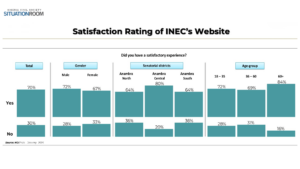
This slide gauges the user experience of the 10 percent of respondents who have accessed the INEC website. The findings indicate a generally positive, yet varied, level of satisfaction. 70 percent of users reported a satisfactory experience, while 30 percent did not. Satisfaction levels varied across demographics, with Anambra Central (80 percent) and voters aged 60 and above (84 percent) reporting the highest levels of satisfaction. In contrast, the Anambra North and South senatorial districts showed lower satisfaction rates at 64 percent. These results suggest that while the website is effective for most users, there remains a significant opportunity to improve to ensure a consistently positive experience for all visitors.
CONCLUSION
The post-2025 governorship election survey presents a mixed but insightful overview of Anambra State’s electoral landscape, highlighting both progress and challenges. Notably, INEC’s operational efficiency and enhanced electoral trust are commendable, yet concerns arise about increased vote-buying and limited online engagement. The decline in voter turnout requires a thorough investigation into the underlying causes and the development of strategies to re-engage the electorate.
To ensure a more robust and credible electoral process, INEC and stakeholders must address these challenges. Key areas for improvement include strengthening anti-vote buying measures and enforcement, enhancing digital outreach and INEC website accessibility, investigating causes of declining voter turnout, boosting voter education visibility through civic organizations, and sustaining operational improvements demonstrated in 2025 Anambra governorship election.
By focusing on these areas, INEC can build on its achievements and improve the overall electoral process, ultimately enhancing the integrity and transparency of future elections in Anambra State.