
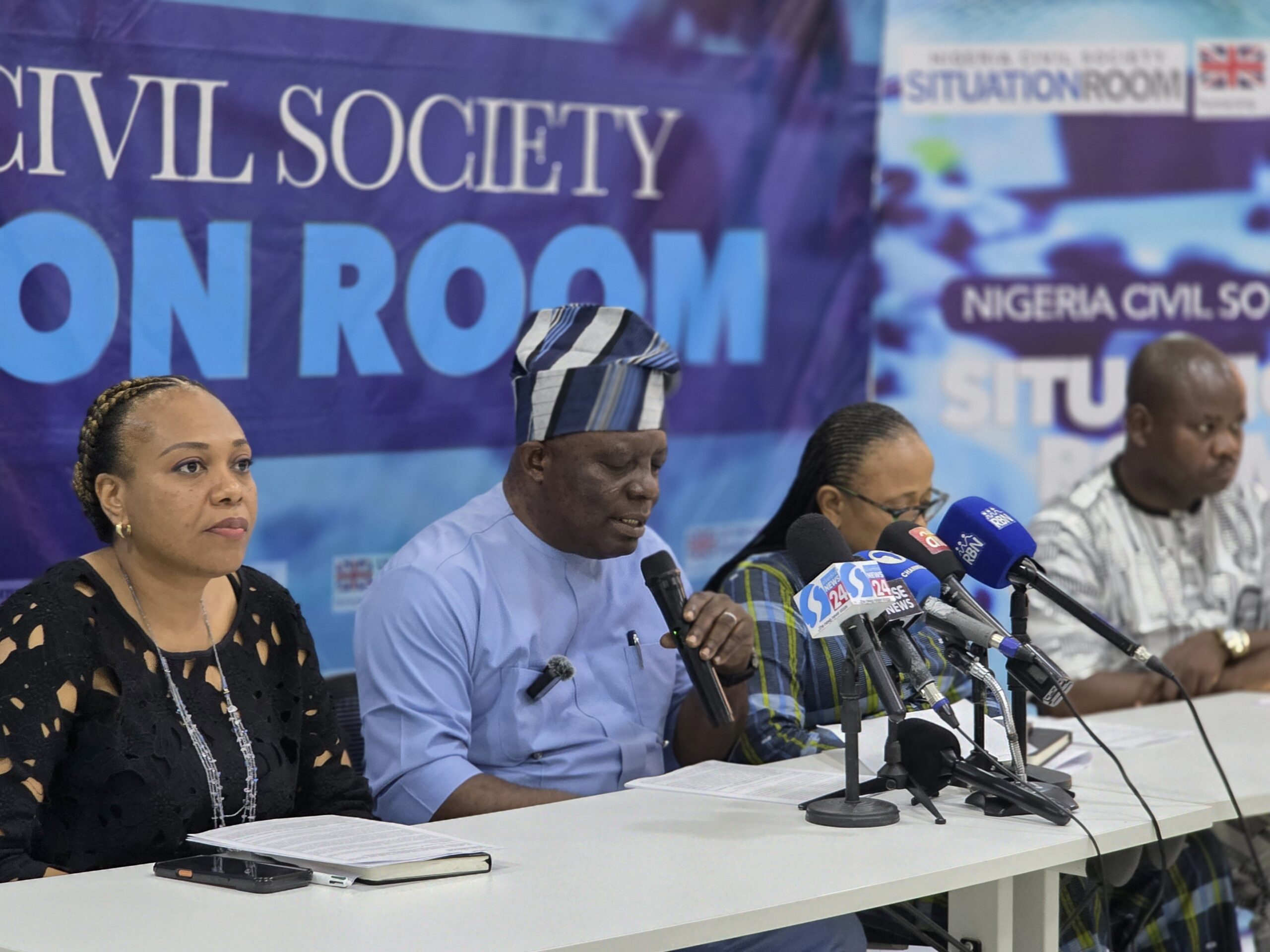
– Issued in Abuja, on Thursday, 5th November 2026 @ 3:30pm
INTRODUCTION
The Nigeria Civil Society Situation Room expresses serious concern over developments in Nigeria’s political environment and their implications for the credibility, inclusiveness and integrity of the 2027 General Elections.
With the Presidential and National Assembly elections scheduled for 16th January 2027 and the Governorship and State Houses of Assembly elections for 6th February 2027, Nigeria is entering a critical phase of the electoral process. Situation Room believes that developments in the weeks preceding the elections will be as consequential to their credibility as the conduct of voting and collation on election day.
The current political environment is characterised by significant political realignments, internal party disputes, concerns about restrictions on political competition, inflammatory rhetoric, election-related violence, questions surrounding electoral technology and the voters’ register, and growing public scrutiny of the independence and preparedness of electoral institutions. These developments are unfolding against a backdrop of insecurity, economic hardship and concerns about the responsiveness and accountability of democratic institutions.
Situation Room recognises the constitutional right of political actors to organise, associate, campaign and seek elective office. We also acknowledge ongoing preparations by the Independent National Electoral Commission (INEC). However, we emphasise that competitive elections require more than the existence of multiple political parties or the administrative readiness to conduct polling. They require a political environment where citizens can freely express their preferences, candidates can compete on fair terms, institutions enforce the law impartially, and every valid vote is accurately counted and reflected in the declared results.
Situation Room maintains that the credibility of the 2027 General Elections must be secured before election day. Nigeria cannot afford an electoral process in which democratic freedoms are weakened, political competition is constrained, and institutional failures erode public confidence in the outcome.
Against this background, the Situation Room draws national attention to eight critical issues requiring urgent intervention:
- POLITICAL PARTY DEVELOPMENTS AND THE SHRINKING SPACE FOR POLITICAL COMPETITION
Situation Room is concerned about the implications of continuing political defections, internal party crises, leadership disputes, contentious party primaries and the growing number of legal disagreements surrounding political party structures and candidate nominations. Recent disputes involving major political parties, including the African Democratic Congress (ADC), Peoples Democratic Party (PDP) and other opposition platforms, illustrate the challenges confronting internal party democracy and the stability of political organisations ahead of the elections.
While political defections, alliances and realignments are legitimate features of democratic competition, Situation Room cautions that persistent internal disputes, competing leadership claims, exclusionary nomination practices and unresolved litigation can diminish citizens’ electoral choices and undermine confidence in the fairness of the political process. We are particularly concerned about allegations of interference in opposition political activities and restrictions on access to venues for lawful political gatherings. Recent allegations by the ADC in Sokoto State concerning intimidation and difficulties securing facilities for political activities emphasise the need for impartial investigation and protection of political freedoms.
Situation Room is also concerned about the growing restrictions on opposition’s visibility through the regulation and cost of campaign billboards and other outdoor advertising. Across several States, governments have introduced or substantially increased fees for political campaign advertisements, with presidential billboard permit fees reportedly standing at ₦200 million in Abia, ₦150 million in Enugu, Kogi and Cross River States, ₦75 million in Rivers and ₦50 million in Anambra. In Benue, the reported fee for presidential campaign billboards is ₦40 million. These charges are particularly concerning when compared with reported conventional billboard rental rates, which range from approximately ₦200,000 to ₦15 million monthly depending on the location and size of the advertising space. Although State Governments have defended the charges as administrative and regulatory fees applicable to all political parties, the scale of the fees raises serious questions about affordability and whether candidates without access to substantial financial resources can compete for public visibility on equal terms.
In the Federal Capital Territory, a widely circulated claim that the FCT Administration had approved a ₦750 million permit fee for presidential campaign billboards was subsequently denied by the FCT Minister’s media aide, the broader concern about unequal political visibility remains relevant. Reports from other parts of the country also point to allegations that opposition parties have been denied access to prime billboard locations, had campaign advertisements destroyed or faced restrictions on the display of their materials. Situation Room stresses that regulation of outdoor advertising must not become a means of limiting political expression or placing opposition parties at a disadvantage. All candidates must have fair and reasonable access to public advertising spaces, and the relevant authorities must ensure that fees, permit procedures and allocation of billboard locations are transparent, proportionate and applied without discrimination.
Situation Room is also concerned by reports of an attack on female ADC supporters during a campaign activity in Sokoto on 28th October 2026, during which the party alleged that its branded campaign vehicle was seized by suspected thugs. The ADC Presidential Campaign Council further alleged that the attackers demanded money before the vehicle could be released and that security personnel failed to intervene. These allegations require an independent investigation and a clear response from the relevant security authorities.
Situation Room emphasises that the right to organise, associate and campaign must be protected equally for all political parties and candidates, irrespective of their political affiliations. We call on INEC to exercise its regulatory responsibilities transparently, consistently and strictly in accordance with the law. Political parties must strengthen internal democratic processes and ensure that nomination procedures are fair, inclusive and compliant with statutory requirements. The strength of Nigeria’s democracy must be measured not merely by the number of registered political parties, but by whether those parties and their candidates can compete freely, fairly and without unlawful interference.
- POLITICAL RHETORIC, INTIMIDATION AND ELECTION-RELATED INSECURITY
Situation Room is alarmed by reports of inflammatory political statements, threats, intimidation, attacks on political activities and other developments capable of undermining peaceful electoral participation.
CLEEN Foundation’s Election Security Threat Assessment records 70 physical election-related incidents across 19 states and the Federal Capital Territory between 1st January and 27th October 2026, with 27 fatalities recorded across 20 distinct incidents. The assessment identifies campaign rallies and party offices as major targets of physical attacks and reports an escalation of violence around party congresses, primary elections and campaign activities. It also identifies the period following the opening of nationwide campaigns as one of increased geographical spread of election-related attacks, with September recording 14 physical incidents. These figures point to a security situation that requires urgent attention well ahead of the 2027 General Elections.
Recent public statements by political actors have further heightened concerns about the tone of political engagement. In August 2026, Senator Francis Fadahunsi was reported to have told supporters to kill members of the Accord Party ahead of the Osun State Governorship Election. Following public condemnation and a police invitation, the Senator said his statement was metaphorical and meant that his supporters should defeat the opposition at the ballot box. While the clarification is noted, statements that can reasonably be understood as calls for violence against political opponents have no place in a democratic contest.
Similarly, on 23rd October 2026, former Deputy Senate President Ovie Omo-Agege, who is contesting for the Delta Central Senatorial seat under the Nigeria Democratic Congress (NDC), reportedly warned that anyone who rigs the 2027 elections would be killed, describing the position as “rig and die”. He subsequently defended the statement as a warning directed at those who manipulate election results rather than ordinary voters. Situation Room recognises the need to deter electoral malpractice, but threats of extrajudicial violence, even when directed at alleged perpetrators of electoral fraud, are unacceptable. Electoral offences must be addressed through lawful investigation, prosecution and judicial processes, not threats of violence.
Situation Room is also concerned by reported incidents of physical attacks on political supporters and campaign activities. On 10th October 2026, supporters of the NDC were reportedly attacked by suspected political thugs at the Akanu Ibiam International Airport in Enugu while gathering to welcome the party’s governorship candidate. A supporter, Ifeanyi Nwolie, was subsequently reported to have died after being shot during the violence. In Ebonyi State, a separate attack on the convoy of an NDC House of Assembly candidate in Ezza South reportedly left one person dead and three others injured.
More recently, the ADC alleged that its governorship candidate’s convoy was attacked near the Sokoto Airport on 30th October 2026 by personnel of the Sokoto Marshal and the State Community Guard. The candidate alleged that gunshots were fired, his vehicle was damaged, and two Department of State Services (DSS) operatives attached to his security team were detained. The Sokoto State Police Command has reportedly commenced an investigation, while the All Progressives Congress (APC) has disputed the ADC’s account. Situation Room calls for a prompt, impartial and transparent investigation to establish the facts and ensure accountability where wrongdoing is established.
The Nigeria Police Force and other security agencies must demonstrate absolute impartiality in the discharge of their responsibilities. Security deployments, investigations and enforcement actions must not favour or disadvantage any political party or candidate. The Situation Room calls for the prompt investigation of documented incidents of political intimidation and violence, including the identification and prosecution of sponsors, organisers and perpetrators. Political violence must not become an instrument for determining who can campaign, who can participate or whose votes will count.
- ELECTORAL ACT 2026 AND SAFEGUARDS FOR TRANSPARENT RESULTS MANAGEMENT
Situation Room recognizes the changes introduced by the Electoral Act 2026 and its impact on Nigeria’s electoral framework, particularly concerning electronic transmission of polling-unit results, election administration and political party processes. While Section 60(3) provides for the electronic transmission of polling-unit results to the INEC Results Viewing Portal (IReV), the provision permitting reliance on the prescribed Form EC8A where electronic transmission fails because of communication difficulties raises important questions about operational safeguards and public accountability.
Situation Room reiterates its longstanding position that transparent, verifiable and accountable results management is indispensable to credible elections. The statutory requirement for electronic transmission must be accompanied by clear procedures that prevent the exception for transmission failure from becoming an avenue for manipulation or arbitrary alteration of election results.
We therefore call on INEC to publicly clarify the procedures for determining genuine communication failures, documenting such incidents, preserving polling-unit results, reconciling electronically transmitted records with physical results forms, and ensuring independent scrutiny throughout the collation process. INEC must also provide clear public guidance on the relationship between BVAS accreditation data, polling-unit results, electronic publication on IReV, collation procedures and the legal mechanisms for resolving discrepancies.
Situation Room further emphasises the importance of effective enforcement of electoral offences and the timely resolution of disputes arising from results management. The integrity of election results must never depend on discretionary interpretations or procedures that cannot withstand independent scrutiny. Every stage of accreditation, counting, transmission, collation and declaration must be transparent and verifiable.
- INEC’s INDEPENDENCE AND OPERATIONAL PREPAREDNESS
Situation Room acknowledges INEC’s ongoing preparations for the 2027 General Elections but stresses that the Commission must demonstrate its readiness through measurable actions, transparent communication and effective safeguards against operational failures.
Situation Room is concerned about the recent nominations and reappointment to INEC announced by President Bola Ahmed Tinubu on 16th October 2026. Situation Room recognises that the President exercises Constitutional powers in the appointment of INEC members, subject to the prescribed consultation with the Council of State and confirmation of the Senate. Given the central role of INEC in determining the credibility of the 2027 elections, the nomination of its leadership must attract rigorous public scrutiny. Concerns have been raised over the reported family relationship between Professor Mustapha Aliu, one of the nominees, and the Governor of Sokoto State, who is seeking re-election on the platform of the APC. While a family relationship does not establish political partisanship or disqualify a nominee, the Senate must carefully examine any credible concerns relating to impartiality, independence and public confidence.
Situation Roomis also concerned about the reported redeployment of Mrs Oluyemi Titilayo Adeyemi-Showunmi from her position as Administrative Secretary of INEC’s Lagos office to head the Commission’s Electoral Operations Department, while the previous head of the department, Isah Magaji Gummi, was moved to the Voter Registry Department. The development has attracted public scrutiny because Adeyemi-Showunmi is married to Segun Showunmi, a member of the APC Presidential Campaign Council thereby making her a politically exposed person in this sensitive position at this time. The Commission has over twenty-two (22) departments and directorates and she could have been posted to any of them.
Situation Room does not suggest that the relationship establishes wrongdoing or that the officer is incapable of performing her duties impartially. However, given the sensitivity of the Electoral Operations Department and its responsibilities for election logistics, the deployment of personnel and other critical election activities, this redeployment raises legitimate questions about the criteria guiding INEC’s internal postings and its choice of such.
Situation Room is also concerned about the recent revelations involving questionable records and photographs suspected to have been generated using Artificial Intelligence (AI) in the preliminary Register of Voters published online on 26th October 2026. INEC acknowledged these concerns in a statement issued on 27th October 2026 and explained that the preliminary register was undergoing verification, claims, objections and data-cleaning procedures. Subsequent explanations attributed some of the irregularities to the actions of registration officers.
While recognising that the Preliminary Register is not the final Certified Register, Situation Room considers these developments sufficiently serious to warrant a comprehensive and transparent investigation. The Commission must explain the nature and extent of confirmed irregularities, identify weaknesses in its registration and verification systems, disclose corrective actions and ensure that no questionable records compromise the final Register of Voters.
The controversy is particularly significant in view of the size of the register that INEC is preparing for the 2027 elections. On 6th October 2026, the Commission announced that the National Register of Voters had risen to more than 103 million following the three-phase Continuous Voter Registration exercise, which recorded 10,772,421 new registrations and a biometric clean-up exercise. With such a substantial number of registered voters, the accuracy, completeness and credibility of the register are fundamental to the legitimacy of the elections. Concerns about suspicious photographs, questionable entries, possible duplicate records and reports by citizens who have experienced difficulty locating their details must be thoroughly investigated and addressed before certification.
INEC has indicated that the final register is expected to be certified by 15th December 2026. Situation Room therefore urges the Commission to publish a detailed report on its verification and data-cleaning exercise before certification. Beyond the voters’ register, INEC must address concerns regarding the availability and collection of Permanent Voter Cards, functionality and deployment of BVAS devices, training of election personnel, procurement and distribution of sensitive materials, cybersecurity, contingency planning and preparedness for transparent collation.
- ABUSE OF INCUMBENCY, PUBLIC RESOURCES AND VOTE BUYING
Situation Room remains concerned about the misuse of public resources, abuse of official authority and the continuing influence of money in Nigeria’s electoral process. We reiterate that public office must not be used to confer unlawful electoral advantages, intimidate political opponents or restrict access to public facilities and resources. The deployment of public funds, government vehicles, state institutions, security personnel or other public assets for unauthorised partisan purposes undermines fair political competition and erodes public trust.
We call on INEC, the Economic and Financial Crimes Commission (EFCC), the Independent Corrupt Practices and Other Related Offences Commission (ICPC), the Nigeria Police Force and other relevant agencies to strengthen election-related financial monitoring and enforcement. Investigations into vote buying, illicit campaign financing and abuse of public resources must be conducted impartially, with appropriate sanctions imposed where offences are established. Nigeria’s elections must not become contests determined by access to public funds, misuse of state authority or the purchasing of citizens’ votes.
- JUDICIAL DECISIONS AND ELECTORAL DISPUTE RESOLUTION
Situation Room recognises the central role of the judiciary in safeguarding constitutional rights, interpreting electoral laws and resolving disputes arising from political party processes and elections. However, we are concerned about the growing number of pre-election disputes involving party leadership, candidate nominations, internal party processes and the interpretation of electoral provisions.
The experience of previous elections has demonstrated that prolonged litigation and late judicial decisions can complicate election preparations, create uncertainty over candidates’ status, and affect the printing of materials, voter information and public confidence. Situation Room stresses that access to justice is a fundamental democratic right and that political actors must be able to seek judicial remedies without intimidation or unlawful interference. At the same time, electoral disputes must be handled efficiently, consistently and in accordance with constitutional and statutory timelines.
Situation Room calls on the judiciary to ensure the timely and transparent determination of electoral matters, while political parties and public institutions must comply with valid court orders and refrain from actions that undermine judicial independence. The courts must remain institutions for the impartial resolution of electoral disputes, rather than arenas in which avoidable delays create uncertainty for voters and election administrators.
- DISINFORMATION, ARTIFICIAL INTELLIGENCE AND THE INTEGRITY OF ELECTORAL INFORMATION
Situation Room is increasingly concerned about the threat posed by misinformation, deliberate disinformation, manipulated images, fabricated political statements, misleading election announcements and the misuse of artificial intelligence during the electoral process.
The circulation of false election timetables earlier in the year, alongside recent controversy surrounding suspicious photographs in the preliminary voters’ register, highlights both the risks associated with emerging digital technologies and the importance of timely, credible institutional communication. AI-generated audio, images and videos could be used to misrepresent candidates, fabricate statements, intimidate political actors, manipulate public perception or circulate false election results.
CLEEN Foundation’s Election Security Threat Assessment also draws attention to the growing use of synthetic media to undermine confidence in electoral institutions and manipulate public perception. The assessment identifies reported cases involving impersonation of INEC officials through fake social media accounts, fabricated election results circulated before official declarations and manipulated images intended to create false impressions of voter behaviour. CLEEN Foundation also warned of what it describes as the “liar’s dividend”, where the widespread availability of deepfakes makes it easier for genuine evidence of electoral malpractice, intimidation or violence to be dismissed as artificial or manipulated. This presents a serious challenge to election accountability, as citizens may become less able to distinguish authentic evidence from fabricated content, while perpetrators may use claims of artificial intelligence to deny genuine wrongdoing.
Situation Room calls on political parties, candidates, media organisations, social media platforms and civil society organisations to promote responsible communication, independent verification and rapid correction of false information. INEC must strengthen its public information systems and ensure that official updates on voter registration, election procedures, polling arrangements and election results are timely, accessible and consistent. We also emphasise that measures to combat disinformation must respect freedom of expression, press freedom and citizens’ rights to hold public institutions accountable. Situation Room will continue to support credible citizen reporting, responsible use of digital tools and independent verification of election-related information. Technology must strengthen electoral transparency and accountability, not become an instrument for voter deception, intimidation or manipulation of democratic processes.
- CITIZEN PARTICIPATION, INCLUSION AND CONFIDENCE IN ELECTIONS
Situation Room is concerned that insecurity, economic hardship, political intimidation, inadequate voter education and declining confidence in electoral institutions may discourage citizens from participating in the 2027 General Elections.
The right to vote must be meaningful and accessible to every eligible citizen, regardless of gender, disability, socioeconomic status or geographic location. In October 2026, INEC acknowledged that insecurity, discrimination and inaccessible polling units could prevent persons with disabilities from participating fully in the elections. This reinforces the need for practical measures to ensure inclusion.
Situation Room calls on INEC to ensure accessible polling units, appropriate assistive materials, adequate voter information and effective arrangements for vulnerable voters, consistent with the law. Political parties must also address barriers to the meaningful participation of women, young people and persons with disabilities in political leadership and candidate selection. Voter apathy must be addressed through credible institutional conduct, improved civic education, peaceful campaigns and public confidence that electoral participation can produce legitimate representation and accountability.
Citizens must be encouraged to register, verify their voter information, obtain their PVCs where applicable, engage political candidates on substantive issues and participate peacefully in the electoral process. Citizens must not be reduced to spectators in a democracy that derives its legitimacy from their participation.
SITUATION ROOM’S DEMANDS AND NATIONAL CALL TO ACTION
In view of the foregoing, the Nigeria Civil Society Situation Room makes the following demands:
- INEC must provide regular and transparent updates on electoral preparedness, publish findings and corrective actions relating to voters’ register irregularities, clarify operational safeguards for electronic transmission and collation, and demonstrate readiness for credible and inclusive elections. The Commission must also provide a clear explanation of the recent internal redeployments that have attracted public scrutiny, publish the criteria guiding the deployment of personnel to critical election departments, and confirm or refute reports of additional polling units, with full disclosure of the relevant details and justification.
- The National Assembly, particularly the Senate, must subject nominees to INEC to transparent and rigorous scrutiny, including examination of any credible concerns about their independence, impartiality and ability to discharge their responsibilities without political influence. The confirmation process must protect public confidence in the electoral institution.
- Political parties and candidates must respect internal democracy, uphold freedom of political association, ensure lawful and fair nomination processes, reject inflammatory rhetoric and intimidation, and commit to peaceful, issue-based campaigns.
- Security agencies must guarantee impartial protection for all political actors, citizens, election officials, journalists and observers, and investigate reported incidents of political violence and intimidation promptly.
- Federal and State Governments must refrain from the misuse of public resources, security structures and official authority for unlawful partisan advantage, and protect the constitutional rights of all political actors.
- The Judiciary must ensure the timely, independent and consistent resolution of electoral disputes, while all political stakeholders must respect valid judicial decisions.
- Anti-corruption and law enforcement agencies must strengthen the investigation and prosecution of vote buying, illicit campaign financing, voter inducement and other electoral offences.
- Media organisations, technology platforms and civil society must promote credible information, counter disinformation responsibly and protect the integrity of public electoral communication.
- Citizens must remain vigilant, participate peacefully, verify electoral information, reject inducements and intimidation, and demand accountability from all institutions responsible for the elections.
CONCLUSION:
Situation Room reiterates that the 2027 General Elections represent another important opportunity to strengthen Nigeria’s democratic institutions and public confidence in electoral governance. However, credible elections cannot emerge from an environment in which political competition is restricted, insecurity discourages participation, public resources are misused, electoral procedures lack transparency or citizens lose confidence in the integrity of their votes.
The responsibility for protecting democracy rests with all stakeholders, but public institutions have a particular obligation to uphold the Constitution, enforce electoral laws impartially and protect citizens’ democratic rights.
We call on political leaders to demonstrate restraint, on institutions to uphold their responsibilities, and on citizens to remain committed to peaceful democratic participation and accountability. The credibility of the 2027 elections will not be determined by what happens on election day alone. It will be determined by the fairness of political competition, the integrity of institutional decisions, the protection of citizens’ rights and the transparency of the electoral process before, during and after voting. Nigeria deserves elections in which every eligible citizen can participate freely, every candidate can compete fairly, and every valid vote is counted accurately.
Signed:
Nigeria Civil Society Situation Room
Abuja, Nigeria
SIGNED:
Yunusa Z. Ya’u
Convener, Nigeria Civil Society Situation Room
Mma Odi
Co-Convener, Nigeria Civil Society Situation Room
Celestine Odo
Co-Convener, Nigeria Civil Society Situation Room
———————-
Contact information:
Call/WhatsApp: 09032999919, 09095050505.
E-mail: situationroom@placng.org
Social Media: @Situationroomng
Website: www.situationroomng.org